1-Bromo-3-Chloropropane: A Look at Its Development and Uses
Historical Development
Long before laboratory precision shaped today’s chemical manufacturing, 1-Bromo-3-chloropropane appeared in research circles as a reliable halogenated alkane. Chemists explored its potential starting in the early twentieth century, driven by a search for practical reagents for organic synthesis. The compound gained prominence because its dual halogen atoms encouraged unique reactions when compared to single-halide chains. As research methods improved, clearer ways of producing and purifying 1-Bromo-3-chloropropane emerged, paving the way for standard use across different scientific fields. Companies began adding it to specialty catalogs, and researchers around the world noticed its value in analytical and preparative work. By the postwar period, it served both academic and industrial projects, from solvent extractions to structural studies, and this tradition still carries on today.
Product Overview
1-Bromo-3-chloropropane stands out among halogenated propanes thanks to its straightforward three-carbon backbone and mixed halide substitution. It’s a clear, colorless liquid at room temperature, easy to handle with regular laboratory equipment. Its density and moderate boiling point suit it for tasks where heavier, higher-boiling solvents become a nuisance. Labs stock 1-Bromo-3-chloropropane most commonly as a specialty chemical—not as a bulk commodity—since its reactivity makes it handy for certain synthetic steps that call for both bromine and chlorine leaving groups. Commercially available containers usually range from small reagent bottles up to medium-scale drums.
Physical & Chemical Properties
With its molecular formula C3H6BrCl and a molecular weight around 157.44 g/mol, 1-Bromo-3-chloropropane combines substantial density with modest volatility. It moves through the air less readily than lighter alkyl halides, which adds a margin of safety during open handling. I’ve found that its boiling point, roughly 142°C, stresses the need for careful temperature control during distillation, since higher temperatures can promote decomposition or fire risk. The compound’s refractive index hovers around 1.48, and it’s sparingly soluble in water but mixes well with nonpolar organic solvents like diethyl ether and hexane. Its pungent odor reminds you quickly to work under a fume hood, as small spills can linger in the workspace.
Technical Specifications & Labeling
Suppliers today offer detailed labeling for 1-Bromo-3-chloropropane, reflecting both legal requirements and best practices. Common specifications include minimum purity, typically over 98%, plus known limits on moisture and impurities like 1,3-dichloropropane or 1,3-dibromopropane. Labels display the chemical abstract service (CAS) number 109-70-6, UN hazardous shipping codes, and recommended storage conditions. Batch-specific certificates often list gas chromatography or NMR purity data, which I find helpful for reproducibility in multi-step syntheses. Packages carry hazard pictograms as required by GHS, alerting users to flammability, acute toxicity, and potential environmental risk.
Preparation Method
Manufacturers typically synthesize 1-Bromo-3-chloropropane by treating 1,3-dichloropropane with sodium bromide in the presence of concentrated sulfuric acid. This halide exchange, often known as the Finkelstein reaction, replaces a chlorine atom with bromine, which proceeds efficiently under controlled heating. For lab-scale use, chemists sometimes modify the route starting from allyl chloride, using addition reactions with hydrogen bromide under mild conditions, followed by suitable purification steps to keep down byproducts. The scalability of the production relies on both reactant cost and the ability to reclaim halide salts from the waste stream, a factor that grows in importance as environmental regulations tighten.
Chemical Reactions & Modifications
1-Bromo-3-chloropropane draws synthetic chemists thanks to its reactivity as an alkylating agent. Its bromine and chlorine atoms serve as excellent leaving groups for nucleophilic substitution reactions, and you can direct its chemistry using standard SN1 or SN2 reaction conditions. For example, strong nucleophiles swap either halogen for new groups, introducing amines, thiols, or azides as needed for downstream synthesis. I’ve participated in projects where 1-Bromo-3-chloropropane anchors a larger scaffold, creating building blocks for pharmaceuticals, agrochemicals, or functionalized catalysts. Heated with bases, it occasionally closes into epoxide rings, and with active metals, coupled products become possible.
Synonyms & Product Names
Besides its IUPAC designation, 1-Bromo-3-chloropropane turns up under trade names and older nomenclature systems. It’s sometimes cataloged as α-Bromo-γ-chloropropane, or 3-Chloropropyl bromide. Some suppliers label it “BCP” for short, while others use descriptive names like 1-bromo-3-chloropropyl hydrogen. Differences in naming can confuse newcomers, so double-checking the CAS number (109-70-6) keeps things straight. I’ve seen regulatory paperwork in various countries list 1-bromo-3-chloropropane under specific hazardous substance codes, which can be important when shipping internationally.
Safety & Operational Standards
Working safely with 1-Bromo-3-chloropropane means more than just gloves and goggles. Exposure irritates skin, eyes, and respiratory tissue, and accidental inhalation carries real health risks, from headaches to longer-term organ effects. Spills, even small ones, should always trigger prompt clean-up, with absorbent pads and venting to reduce lingering fumes. Laboratories keep clear protocols: use inside a fume hood, wear appropriate PPE, and limit access to trained personnel. For waste disposal, separating halogenated organics from other streams matters not only for safety but also for legal compliance and environmental impact. Emergency plans should address both chemical burns and potential fire, since heated vapors can flash ignite under the right conditions.
Application Area
Most of the demand for 1-Bromo-3-chloropropane comes from synthetic laboratories. It acts as a linker in multistep organic syntheses, supporting the assembly of pharmaceutical intermediates and specialty polymers. Researchers use it to functionalize surfaces or polymers where one halogen makes attachment possible, and the second offers later modification. Analytical chemists include it as a phase transfer agent in liquid–liquid extraction of nucleic acids, capitalizing on its immiscibility in water and ease of recovery. Its properties open the door for custom-designed molecules that feed into advanced materials or molecular probes. In recent years, small companies began exploring its potential as a calibration standard in gas chromatography-mass spectrometry (GC-MS).
Research & Development
Current directions in R&D seek to reduce the risk associated with halogenated solvents and intermediates. Researchers test greener synthesis methods, such as using benign solvents or recyclable catalysts. There’s growing interest from medicinal chemists who use 1-Bromo-3-chloropropane to form specific carbon–carbon or carbon–heteroatom bonds when more selective reactions matter. Some efforts go into modifying enzymes or functionalized materials, where the unique reactivity pattern of the compound enables finely tuned modifications. University labs publish data on the compound’s kinetics, showing which bases or nucleophiles give the most efficient substitutions without side reactions.
Toxicity Research
Toxicological studies confirm 1-Bromo-3-chloropropane presents moderate acute toxicity by inhalation, ingestion, or skin contact. Animal studies reveal damage to the liver and kidneys at higher concentrations, along with effects on the central nervous system ranging from drowsiness to confusion. Chronic exposure increases cancer risk, as is the case for many halogenated organics, though direct links remain under investigation. Regulatory agencies cite it as a hazardous air pollutant and recommend tough exposure limits. As chemists pay closer attention to laboratory safety culture, regular monitoring of air quality and periodic health checks for frequent users help address ongoing concerns.
Future Prospects
As environmental standards keep climbing, producers and users of 1-Bromo-3-chloropropane must adapt. Sourcing renewable or less toxic raw materials forms one part of the puzzle, as does improving waste treatment to trap halide runoff before it leaves the factory or lab. There’s continued demand for more efficient, selective reactions to lower cost and reduce byproducts. Some researchers look at bio-based alternatives, but halogenated propanes remain hard to replace in certain niche transformations. Sharing data on both successful syntheses and failures helps refine safe working limits, underpinning new protocols designed for modern laboratory life.
What Drives Interest in 1-Bromo-3-Chloropropane?
People working in labs know the name 1-Bromo-3-Chloropropane (BCP) often pops up in chemical supply catalogs. It’s not a household word, and the bottle usually carries a hazard label. For scientists, BCP fits neatly into a narrow but important space. BCP draws attention mostly because of what it helps make possible, not for splashy headlines.
Scientific Applications: Beyond the Surface
BCP stands out for biologists who want to extract DNA and RNA. Its main claim: separating water from organic solvents inside a tube, so genetic materials jumble less with proteins or fat. A lot of molecular biology methods rely on this separation. BCP gets involved as an alternative to other reagents in phenol-chloroform extraction protocols, acting as the middleman that sharpens the line between what's usable genetic material and what's leftover. Researchers in genomics owe cleaner DNA samples to BCP’s unique mix of properties.
I remember my early days in a genetics lab, bumping elbows with others at a crowded centrifuge. The familiar ritual—add phenol, then BCP, spin fast, watch the layers form—seemed almost like kitchen science. Without BCP, the layers blur, samples get lost, and hours of hard work vanish. That’s why students and senior researchers keep bottles of BCP near the pipettes, despite the sharp chemical smell and the need for gloves.
Chemical Industry: Building New Materials
For chemical manufacturers, BCP behaves less like a mystery and more like a toolkit. Its mixed halogen atoms (one bromine, one chlorine) give it special usefulness in making custom molecules. These atoms work as points for further reactions, so organic chemists turn to BCP in synthesis projects. Pharmaceutical companies, in particular, sometimes use derivatives of this chemical while shaping up new drug molecules. Polymer researchers also use BCP to introduce functional groups onto longer chains, improving properties like strength or flexibility.
Reports from the American Chemical Society point out that small-batch specialty chemicals—like BCP—sit behind breakthroughs, even as public attention drifts toward final products. For every new medicine or coating, there’s often a long supply chain of reagents and intermediates like BCP. Without steady access to this chemical, both research and industry would have their hands tied.
Staying Safe in the Lab
Familiarity sometimes breeds carelessness. Workers new to lab environments quickly realize BCP isn’t the sort of thing you sniff without thinking. Exposure may irritate the skin or lungs, and spills can escalate into safety nightmares, as echoed in safety briefings across universities. Organizations such as the National Institute for Occupational Safety and Health (NIOSH) set guidelines for handling and storage, making sure people don’t take risks.
Many researchers call for greener alternatives, or at least better training for those who use BCP in daily routines. This conversation matters, because cutting corners can lead straight to accidents, especially in startup labs with tight budgets. Reliable sourcing, transparent safety documentation, and routine checks help avoid mishaps and downtime.
Looking at What’s Next
Modern labs cannot give up precision tools, and 1-Bromo-3-Chloropropane is a case in point. Its story teaches that some of the smallest-volume ingredients can support broad fields—genetics, chemistry, medicine—by making careful separation possible. Finding safer ways to use—or even replace—such chemicals will matter as regulations tighten and expectations for lab safety grow. The next wave of research may lead to gentler extraction chemicals or clever techniques that cut out hazards altogether.
As long as scientists keep asking for cleaner separations and faster pathways to new products, BCP will stay in play. Its presence in glass bottles across research labs points to the invisible web connecting chemicals, people, and the discoveries that change how we live.
Breaking Down the Structure
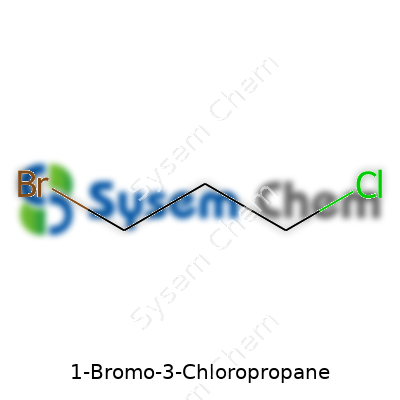
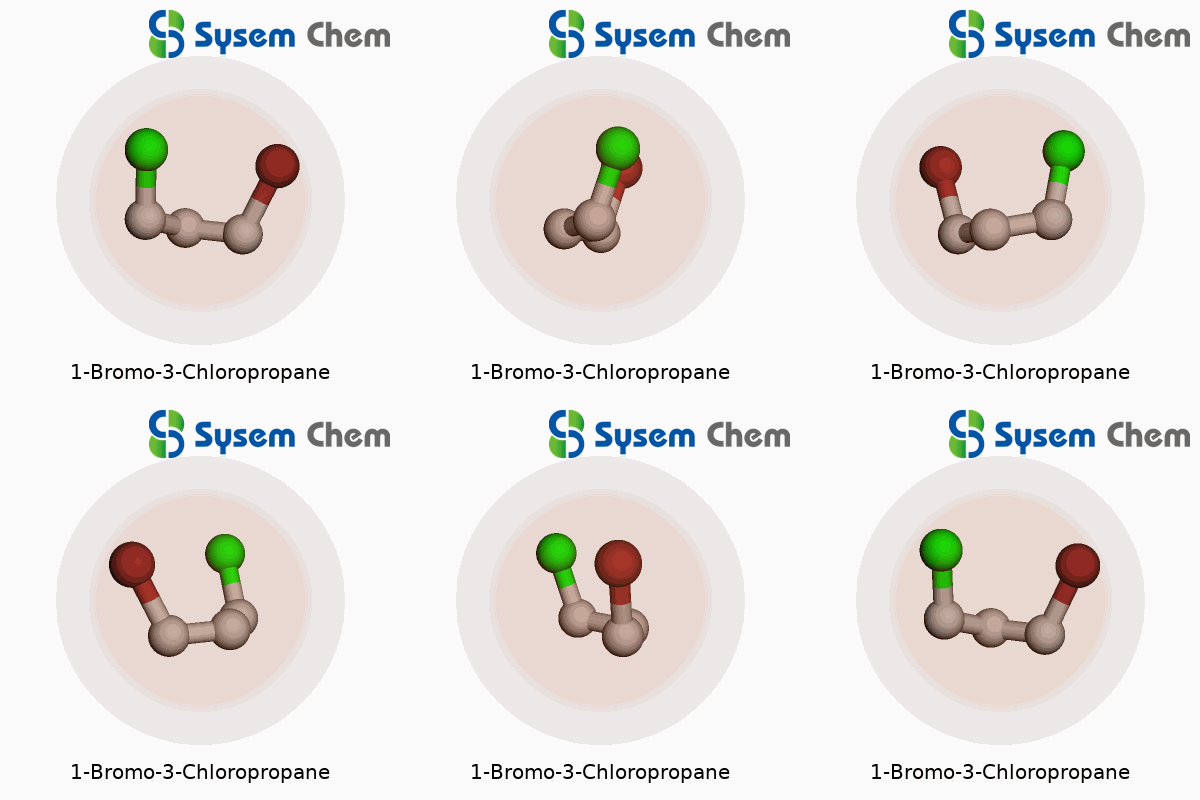
1-Bromo-3-chloropropane sounds intimidating at first glance, but peel back the name and it turns out pretty simple. A backbone of propane—three connected carbon atoms—sits at the core. A bromine atom hangs off one end, while a chlorine atom tags along at the other. Write that arrangement out, and the formula shapes up as C3H6BrCl.
This arrangement means you start with propane, which is C3H8. Swap out two hydrogens on opposite ends for bromine and chlorine, and the rest falls into place. That swap draws straight from the roots of organic chemistry, where functional groups slide in, changing the whole personality of a molecule.
Why This Molecule Matters
On paper, 1-Bromo-3-chloropropane might not turn heads. Step into a research lab, though, and it plays a behind-the-scenes role. Chemists value this compound for what it can do in synthesis—think of it as a tool or a stepping stone. When I worked with halogenated hydrocarbons, handling them demanded attention to detail, from weighing to handling fume hoods, gloves, and proper ventilation. It’s not just about moving atoms around; it’s about respecting the quirks and risks tied to each new compound.
Industry uses compounds like this for building blocks in making chemicals that end up in everything from plasticizers to pharmaceuticals. Change one spot in the formula—a different carbon, a different halogen—and you’ve got something new, with different uses and hazards. That sensitivity is both the thrill and the challenge of chemistry.
Safety and Environmental Questions
Halogenated compounds, especially those swinging halogens like chlorine and bromine, raise good questions about safety. Some structures break down easily, while others stick around in the environment, sometimes building up in living things. My own time in the lab taught me the value of double-checking MSDS sheets and keeping spill kits within arm’s reach.
From an environmental health standpoint, compounds with both bromine and chlorine get extra scrutiny. The use, recycling, and disposal link right into regulations that push for reduced impact. If it lands in water or soil, effects can hang around for years. Regulators expect proof of safety every step of the way.
Charting the Path Forward
Better solutions start with education. It’s easy to overlook the fine print behind a simple molecular formula. Improved labeling and access to safety training helped me and colleagues keep things running safely. Science benefits from rigorous checks on new and old compounds, so real transparency about how 1-Bromo-3-chloropropane gets used—that matters.
Safer alternatives always pull ahead when available, but the transition takes both resources and creativity. Green chemistry looks for routes that cut toxic waste right from the start, all the way down to the formulas at the bottom of a notebook. The real progress comes when everyone from students to experienced researchers values both what a compound can do and what its risks mean for the wider world.
Looking at the Facts
People working around chemicals like 1-Bromo-3-Chloropropane experience the realities behind those intimidating warning labels. This colorless liquid turns up in labs as a solvent and an intermediate, especially in organic synthesis. Research and industry make regular use of it because it helps separate products, drive reactions, and save time in complicated processes. Many see it as a handy tool, but beneath the surface, it carries dangers that deserve attention.
Why This Chemical Demands Caution
Breathing in the vapors from 1-Bromo-3-Chloropropane can irritate the lungs and nose. Even brief skin contact might bring about redness or a rash. It tends to seep into the skin faster than people think, and it can leave folks feeling dizzy, tired, or confused. Long-term exposure doesn’t just risk short-term irritation; it also threatens deeper health issues. Nerve damage, trouble with memory, and liver or kidney injury crop up in some cases. The safety data sheets suggest that it’s probably not something to take lightly, especially if it accidentally splashes or gets handled carelessly. Repeated stories in occupational medicine back this up: people often regret skipping gloves, protective eyewear, or a fume hood, even once.
The Bigger Picture: Workplace Culture and Choices
In my own time spent fiddling with halogenated solvents, the culture inside different labs made all the difference. One shop kept single-use gloves stocked and insisted on proper training before anyone lifted a reagent bottle. Tackling the hazards started with simple steps: labeling everything, keeping bottles closed, and never rushing a process. smaller teams took shortcuts and let safety practices slide. A minor spill left a coworker coughing for hours, all because protective gear seemed like “too much hassle.” Most folks only notice trouble when an accident already happened. I’ve watched how repeated training and open conversations about these dangers kept everyone sharper and less likely to skip the “boring” safety basics that, in the end, matter the most.
Practical Steps That Really Help
Limiting exposure to anything toxic means more than just reading a sheet of instructions. Good ventilation counts for a lot, especially in older labs with poor air flow. Well-fitted gloves—usually nitrile or neoprene—keep the liquid off skin. Safety goggles or face shields protect the eyes from accidental splashes. Responsible storage keeps bottles sealed and far from heat sources. Spills demand more than a wipe-down; proper spill kits and easy-to-understand procedures train users how to handle things calmly. Make sure these tools never gather dust in a supply closet.
Supporting Smarter Habits
Building a safety mindset means nudging habits in the right direction every day. Chatting with the team about near-misses, keeping checklists handy, and rotating refresher training reinforces respect for chemicals like 1-Bromo-3-Chloropropane. In the trade, people sometimes treat routine jobs as less risky, but that’s where costly mistakes creep in. Technology now helps with real-time air monitors and improved personal protective equipment, taking some uncertainty out of the mix. If management invests in clear communication, up-to-date training, and swift response to incidents, workplaces start to look out for everyone—not just the boldest or most experienced chemists.
Lasting Value: Health Over Shortcuts
At the end of the day, taking 1-Bromo-3-Chloropropane seriously protects more than science projects or production quotas. It guards the health of everyone on shift. Smart precautions and respect for safety don’t slow things down in the long run; they build trust and let people focus on what really matters, knowing that nobody will pay for cheap shortcuts with their health.
Why Storage Decisions Matter
Anyone working in a lab—whether college students, chemists, or warehouse staff—has run into volatile and sometimes tricky compounds. 1-Bromo-3-Chloropropane lands squarely on the list of chemicals that ask for respect. It’s a clear, colorless liquid, but don’t let the plain look fool anyone. With established uses in organic synthesis and research, the stakes with safe storage rise fast.
Toxicity and Storage Risks
A whiff of this compound shouldn’t be part of anyone’s workday. According to the National Institute for Occupational Safety and Health (NIOSH), exposure carries risks—including irritation, headaches, and potential long-term health impacts after repeated or careless handling. Fire isn’t the big concern here; this compound won’t burst into flames at the drop of a hat. Its hidden danger comes from fumes, skin contact, and unpredictable reactions with incompatible chemicals.
Conditions Make All the Difference
Heat and sunlight can push this liquid to break down, spoiling experiments and, worse, making labs hazardous. A dark, dedicated cabinet away from heat sources—heaters, direct sunlight, even windows—helps stem the risk. From personal experience, stacking chemicals on open shelves feels like asking for trouble. Splashes happen. Leaks go unnoticed. Storing this one in a flammable substances cabinet—even though it isn’t wildly flammable—keeps it away from people by default and reminds staff to use care.
Separation Rules
Pairing 1-Bromo-3-Chloropropane with the wrong neighbors invites chemical drama. Acids, strong bases, and oxidizers need their own homes. Chemistry isn’t kind to shortcuts. I’ve seen colleagues regret mixing storage, thinking “it’ll only be for a day.” That day is often long enough for trouble. Labeling remains a simple but often forgotten barrier between a safe lab and chemical chaos.
Packaging and Spillage
Glass bottles with screw tops work best here—polyethylene or other plastics can react unpredictably. Repackaging should only happen in fume hoods, not out in the open. Even seasoned lab veterans can spill a drop and only realize it after the headache hits. I keep a spill kit at arm’s reach, not across the facility, since cleaning solvents and absorbents deserve the same respect as the compound itself.
Ventilation Saves the Day
Old buildings keep secrets—one being poor airflow. Pop the lid on 1-Bromo-3-Chloropropane in a tight room and the vapor lingers, putting everyone at risk. A well-maintained fume hood with up-to-date filters isn’t a luxury. It’s non-negotiable. The cleaner the air, the safer the workspace, and the fewer headaches at the end of the shift.
Training and Accountability
Some labs treat chemical storage like common sense. It isn’t. I’ve watched training sessions shorten or skip hands-on steps, leaving newer staff guessing. Policies mean nothing if everyone ignores them, so a seasoned supervisor walking the floor—checking storage, labeling, and spill kits—makes more of a difference than a stack of binders.
Solutions and Culture Shifts
Culture eats policy for lunch. Documented storage procedures, regular checks, annual retraining, and near-obsessive labeling build a workplace that doesn’t leave safety up to memory. If you spot a bottle of 1-Bromo-3-Chloropropane out of place, speak up. Correcting habits before something happens keeps people safe and experiments on track.
References
- NIOSH Pocket Guide to Chemical Hazards: 1-Bromo-3-Chloropropane
- Centers for Disease Control and Prevention, Workplace Safety and Health Topics
- National Research Council, "Prudent Practices in the Laboratory"
Why 1-Bromo-3-Chloropropane Matters
Some chemicals stand out simply by doing their job in labs over and over again. 1-Bromo-3-chloropropane, a mouthful by name, pops up regularly in organic synthesis and lab extraction processes. Folks who work in chemistry spaces know it as a dense, colorless liquid with both a bromine and chlorine atom tagged onto a three-carbon backbone. Its properties end up shaping how chemists handle, store, and use it—so it pays to pay attention.
Physical Properties Worth Noting
Anyone who’s ever unscrewed a bottle of this stuff would notice it doesn’t smell sweet or floral. It lets off that classic halogenated, sharp scent, hinting at its reactive nature. It puddles rather than evaporates from the bench at room temperature because it boils around 142°C. At 20°C, it stays liquid, which lines up with expectations for a molecule of its size and structure.
It's heavier than water, clocking in at a density near 1.6 grams per cubic centimeter. That weightiness comes from bromine and chlorine, two elements known for making things dense. So, if you pour it into water, it sinks. This property actually comes in handy during phase-separation steps in DNA extraction—an experience many life science researchers can recall from their own work.
Handling and Safety in Everyday Practice
No one in a lab ever wants to deal with a spill, but if one happens, the volatility of this compound keeps things contained—its relatively low vapor pressure (about 3 mmHg at 25°C) means fumes rise but don’t fill the room instantly. That said, it’s still a halogenated solvent with a flash point around 32°C, so it catches fire easier than some other liquids if things get out of hand.
I’ve learned to respect these properties. Spill a small amount and you pick up the scent right away, a nudge to turn up the ventilation and don a set of gloves. Researchers have linked halogenated compounds, especially in unventilated spaces, to possible long-term health effects, so responsible use always makes sense. Keeping it capped tightly not only preserves the chemical but also protects everyone in the room.
Where Physical Traits Guide Practical Use
Anyone separating mixtures with 1-bromo-3-chloropropane counts on its density. This liquid sinks, pulling certain components down with it, making phase separations faster and more reliable than water-based solvents could provide. Its clear immiscibility with water—like oil, but heavier—allows for unmistakable layer formation in a tube or beaker. As someone who’s done DNA purification with and without this solvent, the difference stands out. The sharp interface between layers takes uncertainty out of lab work.
Other solvents might have little — or too much — mix with water, messing with results. The unique combo of chlorine and bromine atoms keeps this molecule right on the edge: polar enough to interact with some organics, heavy enough to do the dirty work in layer formation, but resistant to easy mixing with water.
Potential Solutions for Safer and More Sustainable Use
Chemistry moves fast, but a part of progress means doing better by people and the planet. Moving toward safer handling practices stands as a real win—installing dedicated ventilation, limiting exposure times, and providing safety data sheets everyone can understand. When possible, looking for less hazardous substitutes or recycling halogenated waste through proper channels takes the edge off environmental impact. On a personal level, keeping chemical stocks fresh, containers in good repair, and training up to date makes for a safer lab, every day the bottle comes out.